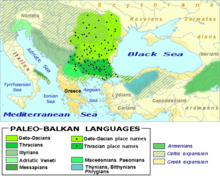
The Thracians ( Greek: Θρᾳκός ; Lat. Thraci ; Bulgarian. Traki ) are an ancient people, a group of Indo-European tribes that lived in the north-east of the Balkan Peninsula and north-west of Asia Minor [1] . They spoke the Thracian language , which is attributed to the Early Indo - European Paleobalkan languages . The powerful tribe of the Thracians - the Odris - founded in 450 BC. e. state in Thrace , subsequently subjugated by Philip of Macedon (with whom Philipopolis arose), in 46 AD e. when Claudius was subordinate to the Romans , from the XIV century belonged to the Turks [2] .
Content
Appearance
The Greek philosopher Xenophanes describes the Thracians as outwardly distinct from the Greeks because of their fair hair and blue eyes.
- Black think of the gods and snub all Ethiopians,
- Thracians think of them with blue eyes and fair-haired ...
- (Translated by F. F. Zelinsky [3] )
Herodotus describes the equipment of the Thracians fighting the Persians:
The Thracians had fox hats on their heads. On the body they wore tunics , and on top - variegated burnos . They had reindeer- skin coils on their legs and knees. They were armed with darts, slings and small daggers ( History , VII, 75)
The Thracians let go of their mustache and beard, and they preferred to collect the hair on their heads at the crown [4] .
Origin
A number of researchers identify the ancestors of the Thracians with the bearers of the Sabatin or Belogrudov culture .
Genetic studies suggest that, after moving from the Carpathians to the Balkan Peninsula, the Indo-Europeans belonging to the haplogroup R1a assimilated with the local Paleobalkan tribes of haplogroup I2a , resulting in the formation - known to us from written sources - of Thracian peoples (in which the haplogroup Ia was dominant R1a); at the same time, a new language was formed on the basis of the language of the conquerors, that is, on the Indo-European basis, incorporating some local features [5] [6] [7] .
In an Eupedia magazine article on red hair genes, the author considers the Thracians to be carriers of the haplogroup R1b [8] .
Historical areas of the Thracians
Thracian tribes (about 200 ethnonyms [9] ) were very numerous and lived on the territory of the modern Balkan Peninsula and parts of Asia Minor.
- Thrace ( Bulgaria and European Turkey )
- Dacia ( Romania )
- Bithynia (northwestern Anatolia )
- Mysia (northwestern Anatolia)
History
The formation and spread of the Thracians to Asia Minor dates back to the era of migration of the peoples of the sea . Homer already places the Thracians on the banks of the Hellespont ( Iliad , II, 845).
By the 5th century BC, the Thracians populated the northeast of the Balkans and the lands adjacent to the Black Sea from the west. Herodotus in the 5th book called them the second (after the Indians ) in number in the known world, and potentially the most powerful militarily - if they stop internal squabbles. In that era, the Thracians were divided into a large number of warring tribes , Xenophon spoke colorfully about their internal wars in his Anabasis . However, the Thracians managed to create for some time fragile states, such as the Kingdom of Odris , the largest in Europe of the 5th century BC, and in Roman times, Dacia , headed by Burebista . After the invasion of the Celtic tribes in Thrace, the kingdom of the Gauls is formed with the capital in the city of Tilis .
Ultimately, most Thracians adopted Greek (in the area of Thrace ) and Roman culture ( Moesia , Dacia and so on) and, in fact, became subjects of these states.
However, small groups of Thracians existed even before the Slavs moved to the Balkans in the VI century AD, that is, it is possible that some Thracians were assimilated by the Slavs .
Archeology
Throughout the 2000s, archaeologists excavate in central Bulgaria , in the area they called the “Valley of the Thracian Kings”. On August 19, 2005, there were reports that it was possible to discover the capital of Thrace near the modern city of Karlovo , Bulgaria. Many smooth fragments of ceramics (pieces of roof tiles and Greek vases) discovered during excavations indicate the wealth of the inhabitants of the city. The Minister of Culture of Bulgaria expressed his support for further excavations.
Records of the Thracians
The records of the Thracians in the Iliad tell mainly about the Hellespont , and about the Kikona tribe, which fought on the side of the Trojans ( Iliad , book II). Many mythical creatures passed from the Thracians to their Greek neighbors, such as the god Dionysus , Princess Europe and the hero Orpheus .
In his fifth book, Herodotus describes the customs of the Thracian tribes:
The tribes living north of the Crusaders have this custom. When someone from the tribe dies, his wives (and all of them have many wives) start a heated debate (with the zealous participation of friends): which of them the dead man loved most of all. Having resolved the dispute, men and women showered the chosen wife with praise and the next of kin stab her on the grave and then interred with her husband. The rest of the wives are very sad that the choice did not fall on them: after all, this is the greatest shame for them.
The customs of other Thracians are as follows: they sell their children to a foreign land. They do not keep the chastity of girls, allowing them to enter into intercourse with any man. On the contrary, fidelity of married women is strictly observed and they buy wives from their parents for a lot of money. A tattoo on the body is considered to be a sign of nobility. He who does not have one does not belong to the noble. A person who spends time in idleness is highly respected by them. On the contrary, they treat the farmer with the greatest contempt. The most honorable they consider the life of a warrior and a robber. These are their most remarkable customs.
Thracians worship only three gods: Ares , Dionysus and Artemis . And their kings (unlike the rest of the people) more than all gods venerate Hermes and swear only to them. According to them, they themselves came from Hermes.
The funeral rites of the wealthy Thracians are as follows. The body of the deceased is exposed for three days. At the same time, they sacrifice all kinds of sacrificial animals and, after funeral screams, they make a trident . Then the body is burned or otherwise interred and, having poured a mound , arrange various competitions. Highest awards are awarded for martial arts, depending on the importance of the competition. These are the burial customs of the Thracians.
Josephus claimed that the father of the Thracians was the seventh son of Japheth , Tiras . He also claimed that the Thracians were originally called Thyrasians, but then the Greeks renamed them.
Thracian tribes
Below is an incomplete list of Thracian tribes :
- Demons
- Bizalts
- Bitins
- Getae [10]
- Ducky :
- Apulites
- Carps (people)
- Costoboks
- Bitch
- Diy
- Kicons
- Honeys
- Flies
- Nipsey [10]
- Odomancy
- Audries
- Siphons
- Pierians (Pierids)
- Satra
- Skyrmiads (Herodotus, History 4:93)
- Travs
- Triballs
- Edons
Not fully Thracian tribes:
- Agafirs ( Scythian- Thracian tribe )
- Dardanians (a tribe mixed of Thracians, Illyrians, and possibly Peonians )
Famous Thracians
- Burebista is the king of Dacia , who subjugated the vast Thracian territory from modern Moravia in the west to the Bug River in the east, from the Carpathians in the north, to Dionisopolis (modern Balchik ) in the south.
- Decebalus is the king of Dacia , who won many battles with the Romans , but was defeated by the army of Trajan .
- Orpheus - in ancient Greek mythology, a singer, musician who played the lyre . He played an important role in the religion of Greece and Bulgaria .
- Spartacus is a Roman gladiator who rebelled on the Apennine Peninsula in 73-71 BC. His army, consisting mainly of escaping gladiators and slaves, defeated several Roman legions in a war known as the “Third Slave War” or “ Spartacus Rebellion ”.
- Maximinus I Thracian (Gaius Julius Ver Maximinus Thracian) - Roman emperor from March 20, 235 to March 22, 238, the first "soldier emperor". Born in a Thracian village, his father was Goth , and his mother was Alan .
Notes
- ↑ Thracians - article from the Great Soviet Encyclopedia .
- ↑ Thrace // Small Encyclopedic Dictionary of Brockhaus and Efron : in 4 volumes - St. Petersburg. 1907-1909.
- ↑ N. Deratani, N. Timofeeva. A reader of ancient literature, vol. I. Greek literature. M .: State. educational ped. Publishing House of the Ministry of Education of the RSFSR, 1958.
- ↑ Beard and hair (inaccessible link) . Date of treatment September 10, 2011. Archived on May 17, 2009.
- ↑ [ http://www.rodstvo.ru/old_i2a.aspx Haplogroup I2
- ↑ Slavs and substrate | Personal site of the Belarusian historian Vyacheslav Nosevich
- ↑ Haplogroup I2 (Y-DNA) / Haplogroup / Home / Anthropological and genetic classifications
- ↑ Maciamo Hay. Red Hair . Eupedia-Genetic . Eupedia.com (2013).
- ↑ Romanesque group
- ↑ 1 2 Herodotus, History 4:93
Literature
- Danov H.M. Drevna Trakiya. - Sofia, 1968.
- Zlatkovskaya T. D. The emergence of the state among the Thracians (VII – V centuries BC). - M. , 1971.
- Thracian art and culture of the Bulgarian lands. Exhibition catalog. - M. , 1974.
- Tsoncheva M. Artistic inheritance in Trakiyskite Zemi . - Sofia, 1971.
- Detschew D. Die Thrakischen Sprachreste. - W. , 1957.
- Wiesner J. Die Thraker. - Stuttg. , 1963.
- Bulgarian Academy of Sciences. History of Bulgaria, Volume 1. - Sofia, 1979.
Links
- Thracians // Great Soviet Encyclopedia.