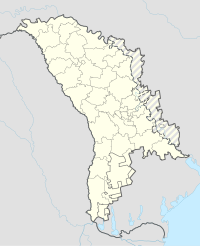


Ekimauci is a Slavic settlement near the village of Ekimauci in the Rezinsky district of Moldova at the end of the 9th century - the 1st half of the 11th century, which belonged to the Tiver tribe.
During excavations, it was found that the settlement was suddenly destroyed as a result of a fierce battle and assault in the 1st half of the 11th century. Most likely, it was burned by nomads (possibly Pechenegs or Polovets ). Since then, the settlement has not been resumed. During excavations in 1950, 1951 and 1952, the expedition uncovered more than 3 thousand m² (0.3 ha) of the area of the settlement. Excavations of G. B. Fedorov in 1950-1952 and 1964 revealed a picture of the defense of the settlement: the skeletons of the fallen in battle, various old Russian and nomadic weapons, traces of conflagrations. Many valuable items have been found for historians. Some of them, the owners themselves, saving from the enemy, buried in the ground, where they survived to this day. Above the hill fort, behind the rampart, and on the opposite northern slope of the hollow, there are simultaneous hillfort fortifications .
The hillfort has an oval shape (plateau size 70 by 86 meters). It was surrounded by a moat about 4 meters deep and a rampart. Dwellings and workshops were located on the inner slope of the shaft, in the center was a reservoir. Thick-walled ceramics from the lower layers of the Ekimautsky hillfort resembles the ceramics of the Slavic villages of the Luka-Raikovec culture , a number of ceramic forms are similar to the forms of the early ceramics of the Moravian Bluchin culture [1] . The main occupations of the population were craft and agriculture. Workshops of a blacksmith and a jeweler with sets of tools and finished products were opened. Found items made in Byzantium and Central Asia . Initially, the fortified settlement in Ekimauts was a community center, as evidenced by the large public house excavated in the center of the fortified site. Around the settlement there was an area of approx. 40 hectares, the inhabitants of which were engaged, in addition to agriculture, in the smelting and processing of iron. This settlement in the X - first half of the XI century acquired the character of an early feudal city [2] . A lot of objects were collected in the ancient settlement, identical to those common in Ancient Russia , and some of them were obviously imported from Kiev . A large number of spindles (parts of a hand spindle ) were found from red slate, which was mined only in one place in Europe - near Ovruch [3] in Volyn , where a spindle was made from it and delivered to Slavic lands. Fine jewelry jewelry, weapons (swords, spear and arrowheads), earthenware were also found. All of them are of the same type as things discovered in other ancient settlements of the Old Russian state .
Along with the Ekimauts, several other handicraft centers were identified in Eastern Europe where workshops that made jewelry decorated with grain were functioning - Alchedar in the Prut-Dniester region, Chervon on the Southern Bug, Iskorosten on the Dnieper Right Bank [4] .
Notes
- ↑ Ekimautsky settlement
- ↑ Tymoshchuk B.A. Ancient Russian cities of Northern Bukovina
- ↑ Rosenfeldt R. L. On the production and dating of Ovruch spindle-wheels // SA. 1964. No. 4. P. 233.
- ↑ Ryabtseva S.S. , Telnov N.P. Alchedarsky treasure and centers of jewelry production in Eastern Europe at the end of IX - beginning of XI centuries. // Stratum plus 2010 No. 5. Chisinau, Odessa, Bucharest 2010.S. 285-300.
Literature
- Fedorov G. B. Slavs of Transnistria // Following the Traces of Ancient Cultures. Ancient Russia. - M. , 1953. - S. 121-155.
- Fedorov G. B. Settlement Ekimautsy. - KSIIMK, 1953, no. 50, p. 104-126.
- Mokhov N.A. Moldavia of the era of feudalism. - Chisinau: Cartya Moldovenenasca, 1964. - S. 78-79.
- Fedorov G. B. Posad Ekimautsky settlement // Culture of ancient Russia. M., 1966, p. 272-277.