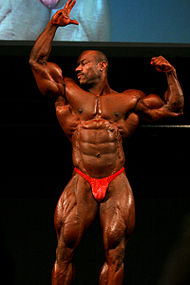
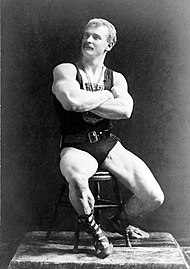
Bodybuilding (from the French culturisme - body culture), or bodybuilding (from the English body - the body [1] and building - construction [1] ) - the process of building ( hypertrophy of skeletal muscles) and the development of musculature of eating large amounts of food, high-energy special nutrition (with a high content of nutrients, in particular proteins ), sometimes pharmacological preparations (including in the form of injections) with a visit to (or without) a gym for performing physical exercises with weights
A person who is engaged in weight lifting in order to increase the volume or quality of muscles (density, relief) is called a bodybuilder or bodybuilder, in colloquial terms - pitching. Competitive bodybuilding is a competition in which judges evaluate the muscles of posing participants based on selection criteria by volume, aesthetics of proportions, as well as symmetry and balance, and determine a bodybuilder with the most perfect body. Since 1960, bodybuilding began to hold competitions where athletes demonstrated their musculature.
Bodybuilding History
The early years
The period from 1880 to 1953 is usually referred to the early stage of the existence of bodybuilding.
1950-1960s
Bodybuilding gained great popularity in the 1950s and 1960s. The greatest propaganda was provided by Charles Atlas , whose advertising in comics and other publications based on muscular superheroes led many young people to begin to study ways to develop the body. It was then that the most famous contests and competitions appeared, such as " Mr. Universe " and "Mr. America." It is these competitions that paved the way for other modern competitions. At that time, many magazines popularizing bodybuilding appeared - Strength & Health and Muscular Development . Filming some bodybuilders in the cinema also only added to the sport of popularity. The most popular movie was Steve Reeves , who played the roles of Hercules , Samson and other legendary heroes.
1970s - Present
Using Anabolic Steroids
Despite the fact that anabolic steroids appeared a long time ago, it was the 1970s that they called the “uprising of anabolic steroids” [2] , and not only in bodybuilding, but also in other sports. In bodybuilding, this is due to a sharp jump in muscle volumes, starting with Arnold Schwarzenegger , Franco Colombo , Louis Ferigno , Dorian Yates , Lee Haney and Paul DeMaillot, as well as the appearance of athletes such as Rich Gaspari and Andreas Muenzer . Although an open discussion of the use of anabolic steroids began in the 1970s, until the 1990s they were legal remedies. In 1990, the US Congress added anabolic steroids to the list of "controlled substances." In Canada, due to the scandal with Ben Johnson at the Olympics in Seoul , the Penal Code of Canada introduced liability for the use of steroids. Steroids are assigned to the 6th class of potent substances.
World Federation of Bodybuilding
In 1990, wrestling promoter Vince McMan announced the formation of a new organization, the World Bodybuilding Federation . Thus, he wanted to add more entertainment to bodybuilding and increase the prize pool of tournaments. However, in July 1992, the WBF was formally dissolved. Among the reasons include the lack of revenue from paid broadcasts of WBF contests, the small sales of the Federation magazine Bodybuilding Lifestyle (which later became WDF magazine), as well as the high costs of producing two television shows and publishing a monthly magazine.
Bodybuilding as an Olympic sport
At the beginning of 2000, the International Federation of Bodybuilders & Fitness tried to give bodybuilding the status of an Olympic sport, due to the fact that in 2000 this organization received full membership in the International Olympic Committee . Thus, the IFBB sought to establish bodybuilding as a full-fledged form at the Olympics . However, this did not happen, as many do not recognize bodybuilding as a sport.
Bodybuilding in the USSR and Russia
Traditionally, a demonstration of physique and strength in the USSR was associated with a circus. So, in 1948, in the Tchaikovsky Concert Hall in Moscow , a physique beauty contest was held, the winner of which was the famous circus acrobat Alexander Shirai [3] .
In the USSR, bodybuilding was not banned, however, it did not have state support, therefore, it was mainly practiced in the so-called “rocking chairs” (amateur gyms , usually in the basements held by enthusiasts). The first bodybuilding gym in the Soviet Union was opened in 1962 in Leningrad ; massively “rocking chairs” began to open from the late 1960s throughout the country [4] [5] [6] . With the support of the local leadership, the administration of gyms and cultural centers, amateur tournaments were held [7] . In 1968, the first open All-Siberian Athletic Competition was held in Tyumen , and the second competition in 1969 was the first in the USSR with the participation of foreigners [5] .
In February 1971, the first unofficial USSR Championship was held in Severodvinsk , the first place was taken by the Severodvinsk athlete Alexander Lemekhov, the second place - Vladimir Dubinin from Leningrad, the third - Vladimir Khomulev from Severodvinsk.
On February 26-28, 1972, the second USSR championship was held in the same place, consisting of a competition in power disciplines and a competition in bodybuilding. The power competition program, which consisted of a bench press and squats, ended with the following results:
| a place | member name | city | bench press kg | squat, kg |
|---|---|---|---|---|
| Category up to 168 cm: | ||||
| I | Victor Yashin | Severodvinsk | 162.5 | 190 |
| II | Vladimir Lipianen | Leningrad | ||
| III | Boris Zhitkov | Kaliningrad | ||
| Category up to 175 cm: | ||||
| I | Sergey Kizin | Leningrad | 165 | 220 |
| II | Valentin Watching | Severodvinsk | 155 | 185 |
| Categories over 175 cm: | ||||
| I | Vladimir Dubinin | Leningrad | 192.5 | 195 |
| II | Alexander Lemekhov | Severodvinsk | 175 | 250 |
| III | Alexander Chernykh | Moscow | 182.5 | 230 |
Before the competition in bodybuilding, participants had to swim 50 meters freestyle in 45 seconds. The freestyle program and muscle development competitions were held in accordance with the rules of the IFBB Federation competition. The results are as follows:
- Category up to 168 cm:
- Vladimir Lipianen (Leningrad);
- Boris Zhitkov (Kaliningrad);
- Dmitry Chanev (Severodvinsk).
- Category up to 175 cm:
- Valdas Alabavichus (Vilnius);
- Sergey Kizin (Leningrad), he was deprived of a gold medal for failure to comply with the swimming standard;
- Alexander Nikiforov (Astrakhan).
- Categories over 175 cm:
- Vladimir Dubinin (Leningrad);
- Alexander Lemekhov (Severodvinsk);
- Vladimir Khomulev (Severodvinsk).
In the team championship, the first place went to the hosts of the tournament - the Severodvinsk team, receiving the “White Sea Cup”, the second - the team of Leningrad, the third - Moscow. The Chairman of the Federation of Bodybuilding in the city of Severodvinsk Vladimir Khomulev, the editors of the journal “Sports Life of Russia”, was awarded the diploma “For the promotion and development of bodybuilding in the USSR” [8] .
With the beginning of perestroika, bodybuilding has become a very popular, rapidly developing sport. On August 11, 1987, the USSR Athletic Federation was founded [9] .
In 1988, in Leningrad, under the auspices of the USSR State Sports Committee, the first USSR Cup in men's free exercise was held. The first official USSR athletics championship was held on May 26–28 of the same year in Leningrad with the following results: in the weight category up to 65 kg - Alexander Shumlyansky (Ukraine), up to 70 kg - Valery Bogdanovich (Belarus), up to 80 kg - Vintsas Dubickas (Lithuania), up to 90 kg - George Mosalev (Moscow) and over 90 kg - Richard Petrauskas (Lithuania). In the team event, the first place was won by the combined team of bodybuilders of the Ukrainian SSR, the second - Lithuanian and the third - Leningrad athletes [3] .
In 1988, athletes from the USSR took part in the World Cup of Bodybuilding in Australia for the first time: Valery Bogdanovich (Minsk), Stanislav Polyakov (Riga) and Alexander Vasin (Leningrad), taking fourth place in the team event. During these competitions, the Soviet Union was admitted to the International Bodybuilding Federation IFBB [3] . In June 1988, IFBB President Ben Wyder visited the USSR during his visit: “I believe that, due to special national traditions, bodybuilding will become the dominant sport in the USSR. When this happens, Soviet bodybuilding will turn into the main driving force of this sport all over the world ” [9] .
In 1989, international success came to domestic bodybuilding: Belarusian Nikolai Shilo became the European champion in the category up to 65 kg, and up to 70 kg the Russian was Russian Stanislav Polyakov, and the Soviet team debuted first place in team posing. In the same year, the first international tournament "Grand Prix" Tyumen-89 "" [5] [6] was held in Tyumen.
On April 26-29, 1990, the European Championship in bodybuilding was held in Leningrad. Ain Paavo became the champion of Europe in the category of up to 90 kg. The first place in team posing was given to the Soviet team [3] .
Now only three Russian professionals, Alexei Lesukov , Sergey Shelestov and Evgeny Mishin , take part in international tournaments of the highest category. In 2008, Sergey Shelestov took 17th place in the competition “ Mr. Olympia ”. His result was repeated by Eugene Mishin in 2010. Other professionals: the tournament "Mr. Universe" (NABBA) - in 2005, the winner is Sergey Ogorodnikov, in 2009 - Alexey Netesanov. Among fans in 2014, Alexei Yurchenko - finalist - 5th place.
Bodybuilding
Bodybuilding
In the modern bodybuilding industry, a professional is usually called a bodybuilder who won in qualifying competitions as an amateur and earned a “Pro Card” from IFBB. Holders of this card get the right to speak at professional tournaments, for example, Arnold Classic and Champions Night. In turn, the high results shown in such competitions give them the opportunity to participate in the competition “ Mr. Olympia ”. The title “Mr. Olympia” is the highest award in the field of professional bodybuilding.
Bodybuilding "no chemistry"
There are organizations that promote the so-called "natural" bodybuilding. These include:
- North American Natural Bodybuilding Federation (NANBF) [10] ;
- “The International Natural Bodybuilding & Fitness Federation” (INBFF) [11] ;
- Australasian Natural Bodybuilding Association (ANBA) [12] ;
- "International Natural Bodybuilding Association" (INBA) [13] ;
- Natural Physique Association (NPD);
These associations promote bodybuilding without the use of anabolic steroids or pharmacological agents . Adherents of bodybuilding "without chemistry" believe that their method is more focused on a healthy lifestyle and natural competition.
Female bodybuilding
The first American Women's National Championship, Phisique, was held in Canton , Ohio in 1978, thanks to Henry McGee. It was the first female competition in the world where participants were judged solely by musculature. Since then, many women's competitions have been held, the most prestigious of which is considered to be Miss Olympia. The first winner of the competition, held in 1980, was Rachel McLeish [14] . Oksana Grishina , a Russian athlete in bodybuilding and fitness, became the three-time Arnold Classic champion in the Fitness nomination in the USA, also three-time in Spain, and one-time in Australia. [15] Grishina is the first and so far the only female athlete in Russia who won the IFBB card to participate in the IFBB Olympia competition, and also became the champion at world bodybuilding and fitness competitions.
Muscle Growth
Training
Medicine recognizes that all people are the same in the anatomical and physiological sense. With regard to bodybuilding, the physiology of people does not change. The principles of effective training techniques are unchanged and scientifically accurate for everyone. Pluralism about the multiplicity of muscle building methods is not always justified and can be harmful to health.
Although people are the same in physiological and anatomical terms, it is known that “red” and “white” muscle fibers (muscle cells) are part of the muscles. The former are responsible for the possibility of long-term work ( styers ), the latter for short-term powerful work ( sprinters ). Since both fibers are part of the muscle, the muscles of different people differ in the ratio of these fibers. At the same time, the total number of fibers in one muscle of different people is not the same [16] . Constitutional body types are also known: Endomorph (since birth, a lot of fat and a little muscle), Ectomorph (from birth there are few muscles and little fat), Mesomorph (a lot of muscles, little fat).
Therefore, the training methods can and should be different, because a person who wants to become a bodybuilding star does not know how many muscle fibers he has. It is by trial, error and self-observation that he identifies suitable load options for muscle growth. And it doesn’t matter anymore whether the white or red fibers prevail in him, the main thing is that these predominant fibers are loaded and grown. Although, of course, it is easier and faster to increase mass with white fibers, because their effectiveness depends on their thickness (the number of contractile proteins), and on red fibers, on other, more subtle factors (for example, the number of mitochondria in a cell).
Nutrition
High rates of muscle recovery and growth require bodybuilders to follow a specialized diet . Bodybuilders need more calories than the average person of the same weight to provide protein and energy for the cost of training, recovery, and proper muscle growth. Reducing the level of food energy in combination with cardiovascular exercises allow bodybuilders to lose excess fat , which is important in preparation for various competitions. The ratio of food energy derived from carbohydrates , proteins and fats can vary depending on the goals of the bodybuilder.
For proper nutrition, it is not enough to determine only the calorie content of food; you also need to know what nutrients and in what quantity can provide this calorie content, that is, determine the qualitative composition of food. When 1 gram of protein or carbohydrate is oxidized in the body, 4.1 kcal is formed , and when 1 gram of fat is oxidized, 9.3 kcal. If necessary, carbohydrates and fats can partially replace each other; as for protein substances, they cannot be replaced by any other food substances [17] .
Meals
An average person eats food three times a day. Bodybuilders try to eat 5-7 times a day (every 2-3 hours). This method has two goals: increasing the metabolic rate, as well as preventing excessive secretion of insulin caused by too much one-time meal. Many bodybuilders always carry with them a plastic container with food, to minimize disturbance in the regime of eating. In a quality diet, the ratio should be as follows: carbohydrates - 50%; proteins - 30%; fat - 20% [18]
Squirrels
Protein is the main building material of the body, which is necessary for the growth of muscle fibers and their recovery, and therefore bodybuilders pay special attention to its intake. A bodybuilder needs more protein than an ordinary person. According to various estimates, he needs to consume 1.5-2 or more grams of protein per kilogram of weight, while protein should account for up to 25-30% of the total calorie intake [19] . The main sources of protein for bodybuilders are chicken , turkey , beef , pork , fish , eggs and high protein dairy products , as well as some nuts and legumes . In addition, many bodybuilders supplement their diet with various protein supplements, such as casein or whey protein .
Carbohydrates
The total energy value of the diet is calculated by adding together the energy components of proteins, carbohydrates and fats. The energy value of 1 gram of protein is 4 kcal, carbohydrates - 4 kcal, fat - 9 kcal. The nature of metabolism involves the use of carbohydrates and fats as an energy source. Proteins for the body are primarily building material; from them carbohydrates can be synthesized with a lack of nutrition. The main sources of energy for the body remain carbohydrates and fats. Moreover, depending on the type of physical activity, the body gives greater preference to either fats or carbohydrates. As for bodybuilding, here a non-competitive source of energy is carbohydrates. It is they who determine the general physiological tone of the bodybuilder and ultimately the success of his training.
Rest
Although muscle growth stimulation occurs in the gym due to weight training, growth itself occurs during rest. Without adequate rest and sleep, muscles are unable to recover and grow. For full-fledged muscle growth, a bodybuilder needs about eight hours of night sleep, although each person has this indicator. In addition, many athletes find time for daytime sleep, which further stimulates further muscle growth.
Overtraining
Too much exercise or too little rest between workouts leads to overtraining [20] . If you start the next workout without having enough rest, fatigue will accumulate. It is important to find the right rest period between workouts. On average, with three workouts a week, there are 1-2 days of rest, with two - 2-3 days. Sometimes people need up to 9 days of rest between workouts.
Bodybuilding in popular culture
Many bodybuilders during and after the completion of their careers begin to engage in various activities. Among the professions most popular among bodybuilders, there are actors , models , trainers , strippers . Often the choice is in favor of professions for which it is necessary to have beautiful external data or substantial physical preparation. To date, many bodybuilders have been successful outside the competition podium. In recent years, in connection with the spread of ideas of a healthy lifestyle , an amateur variety of bodybuilding is popular - fitness . Bodybuilding is popular not only among young people; Today in different countries competitions are held among various age categories, up to 80 years. One of the most famous retired bodybuilders is the Japanese Tsutomu Tohsaka .
See also
- Supercompensation
- Krepatura
- Sportwiki
- Body modifications
Notes
- ↑ 1 2 Muller V.K. English-Russian Dictionary. - 24th ed., Revised. - Moscow: “ Russian language ”, 1995.
- ↑ Anabolic steroids
- ↑ 1 2 3 4 “Power Martial Arts” - L. S. Dvorkin
- ↑ Gromov D.V. Lyubertsy street youth companies of the 1980s (Inaccessible link) . Date of treatment May 26, 2009. Archived January 30, 2009.
- ↑ 1 2 3 “The phenomenon of Eugene Koltun” (inaccessible link) . The Iron World Magazine
- ↑ 1 2 “FORTY STEPS ON OLYMPUS” - Parliamentary newspaper “Tyumen News”
- ↑ "Bodybuilding in the USSR . " Kalinin, DK Khimvolokno, 1973
- ↑ 2nd USSR bodybuilding championship
- ↑ 1 2 Soviet bodybuilding (inaccessible link)
- ↑ www.nanbf.org - North American Natural Bodybuilding Federation.
- ↑ www.inbf.net - “The International Natural Bodybuilding & Fitness Federation”.
- ↑ www.anb.com.au - Australasian Natural Bodybuilding Association.
- ↑ www.naturalbodybuilding.com - International Natural Bodybuilding Association.
- ↑ "History of Bodybuilding" (Unavailable link) . Date of treatment February 28, 2010. Archived on May 6, 2010.
- ↑ OXANA GRISHINA - SportWiki Encyclopedia
- ↑ Journal of Health No. 11, 1984
- ↑ Main editors of the Big Medical Encyclopedia of the USSR Academy of Medical Sciences. Section "Nutrition". // Popular medical encyclopedia / Chap. ed. F.N. Petrov, A.F. Sirenko. - 7th stereotypical. - M .: Soviet Encyclopedia, 1969. - S. 595. - 924 p. - 150,000 copies. - ISBN T-08432.
- ↑ Bodybuilder Diet: Food Set, Nutrition Features and Recommendations
- ↑ Lambert CP, Frank LL, Evans WJ. Macronutrient considerations for the sport of bodybuilding. Sports Med . 2004; 34 (5): 317-27. PMID 15107010
- ↑ Russindragon.org - "The Harm of Bodybuilding" (inaccessible link)
Literature
- "A complete bodybuilding course from beginners to professionals." - M .: AST; Mn .: Harvest, 2002. - ISBN 5-17-000406-0 , 985-13-0863-3.