Clever Geek Handbook
📜 ⬆️ ⬇️

Planck energy

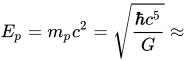
Plankovsky energy is a physical constant numerically equal to the Planck mass times the square of the speed of light . In a Planck system of units, Planck energy is a unit of energy . DesignatedEP {\ displaystyle E_ {P}} E_ {P} .

Ep=mpc2=ℏc5G≈{\ displaystyle E_ {p} = m_ {p} c ^ {2} = {\ sqrt {\ frac {\ hbar c ^ {5}} {G}}} \ approx} E_ {p} = m_ {p} c ^ {2} = {\ sqrt {{\ frac {\ hbar c ^ {5}} {G}}}} \ approx 1,956⋅10 9 J≈ {\ displaystyle \ approx} \ approx 1.22⋅10 28 eV≈ {\ displaystyle \ approx} \ approx 543.3 kWh≈ {\ displaystyle \ approx} \ approx 4.6718⋅10 8 cal .

For comparison, it exceeds by about eight orders of magnitude the maximum measured energy of cosmic rays and by about 6% the muzzle energy of the most powerful artillery gun in history - the 800 mm Dora railway cannon :

EDora=mv22≈7100∗72022≈{\ displaystyle E_ {Dora} = {\ frac {mv ^ {2}} {2}} \ approx {\ frac {7100 * 720 ^ {2}} {2}} \ approx} E _ {{Dora}} = {\ frac {mv ^ {2}} {2}} \ approx {\ frac {7100 * 720 ^ {2}} {2}} \ approx 1,840⋅10 9 ( J )

In the Planck era , about 13.8 billion years ago, the substance of the Universe had Planck energy, Planck radius ( 10–35 m), Planck temperature (10 32 K) [1] and Planck density (~ 10 97 kg / m³).

Content

  • 1 Connection of photon energy and gravitational signal delay
  • 2 See also
  • 3 notes
  • 4 Literature
  • 5 Links

The relationship of photon energy and gravitational signal delay

For a signal traveling around a point gravitational mass , the gravitational delay can be calculated using the following formula:

Δt=-2GMc3ln⁡(one-R⋅x).{\ displaystyle \ Delta t = - {\ frac {2GM} {c ^ {3}}} \ ln (1- \ mathbf {R} \ cdot \ mathbf {x}).}   (one)

HereR {\ displaystyle \ mathbf {R}}   Is a unit vector directed from the observer to the source, andx {\ displaystyle \ mathbf {x}}   Is the unit vector directed from the observer to the gravitating point of mass M.

It follows that in order to cause a signal delay equal to a fixed and a priori specified time intervalτ {\ displaystyle \ tau}   mass required

M=-τc32ln(one-R⋅x)G.{\ displaystyle M = - {\ frac {\ tau c ^ {3}} {2ln (1- \ mathbf {R} \ cdot \ mathbf {x}) G}}.}   (2)

The energy equivalent to this mass is:

Eone(τ)=-τc52ln(one-R⋅x)G.{\ displaystyle E_ {1} (\ tau) = - {\ frac {\ tau c ^ {5}} {2ln (1- \ mathbf {R} \ cdot \ mathbf {x}) G}}.}   (3)

On the other hand, the quantum energy of EM radiation with a periodτ {\ displaystyle \ tau}   is equal to

E2(τ)=hτ=2πℏτ.{\ displaystyle E_ {2} (\ tau) = {\ frac {h} {\ tau}} = {\ frac {2 \ pi \ hbar} {\ tau}}.}   (four)

The product of these 2 energies defined by formulas (3) and (4) is equal to:

Eone(τ)E2(τ)=-τc52ln(one-R⋅x)G2πℏτ=-2πℏc52ln(one-R⋅x)G=-πℏc5ln(one-R⋅x)G=-πEP2ln(one-R⋅x).{\ displaystyle E_ {1} (\ tau) E_ {2} (\ tau) = - {\ frac {\ tau c ^ {5}} {2ln (1- \ mathbf {R} \ cdot \ mathbf {x} ) G}} {\ frac {2 \ pi \ hbar} {\ tau}} = - {\ frac {2 \ pi \ hbar c ^ {5}} {2ln (1- \ mathbf {R} \ cdot \ mathbf {x}) G}} = - {\ frac {\ pi \ hbar c ^ {5}} {ln (1- \ mathbf {R} \ cdot \ mathbf {x}) G}} = - {\ frac { \ pi E_ {P} ^ {2}} {ln (1- \ mathbf {R} \ cdot \ mathbf {x})}}.}   (5)

Thus, the product of the energy equivalent to the mass causing the delay is equal toτ {\ displaystyle \ tau}   , and photon energies with a periodτ {\ displaystyle \ tau}   independent ofτ {\ displaystyle \ tau}   and equal to the square of Planck energy up to a dimensionless coefficient:-πln(one-R⋅x) {\ displaystyle - {\ frac {\ pi} {ln (1- \ mathbf {R} \ cdot \ mathbf {x})}}}   .

Accordingly, the ratio of these 2 energies is equal to

Eone(τ)E2(τ)=-τ2c5fourGπln(one-R⋅x)ℏ==τ2fourπln(one-R⋅x)tP2=-onefourπln(one-R⋅x)(τtP)2.{\ displaystyle {\ frac {E_ {1} (\ tau)} {E_ {2} (\ tau)}} = - {\ frac {\ tau ^ {2} c ^ {5}} {4G \ pi ln (1- \ mathbf {R} \ cdot \ mathbf {x}) \ hbar}} == {\ frac {\ tau ^ {2}} {4 \ pi ln (1- \ mathbf {R} \ cdot \ mathbf {x}) t_ {P} ^ {2}}} = - {\ frac {1} {4 \ pi ln (1- \ mathbf {R} \ cdot \ mathbf {x})}} ({\ frac { \ tau} {t_ {P}}}) ^ {2}.}   (6)

WheretP {\ displaystyle t_ {P}}   - Planck time .

See also

  • Planck era
  • Maximon
  • Planck black hole
  • Great Unification Energy

Notes

  1. ↑ "God and the Multiverse." Chapter from Victor Stenger's Chaotic Inflation Book

Literature

  • Peter J. Mohr and Barry N. Taylor. CODATA recommended values ​​of the fundamental physical constants: 2002 (eng) // Reviews of Modern Physics : journal. - January 2005. - Vol. 77 . - P. 1-107 .

Links

  • Lectures on General Astrophysics for. 1.5 Planck units


Source - https://ru.wikipedia.org/w/index.php?title=Pankovskaya_energy&oldid=101035747


More articles:

  • Manteifel, Ivan Vasilievich
  • Bazin, Francois (composer)
  • Syzdykov, Tito Uakhapovich
  • Sverdlovsk Art College
  • Flower and the Mole
  • Alraun
  • Pneumoconiosis
  • Suvorov Military School
  • Iguazu (river)
  • Tank Car

All articles

Clever Geek | 2019